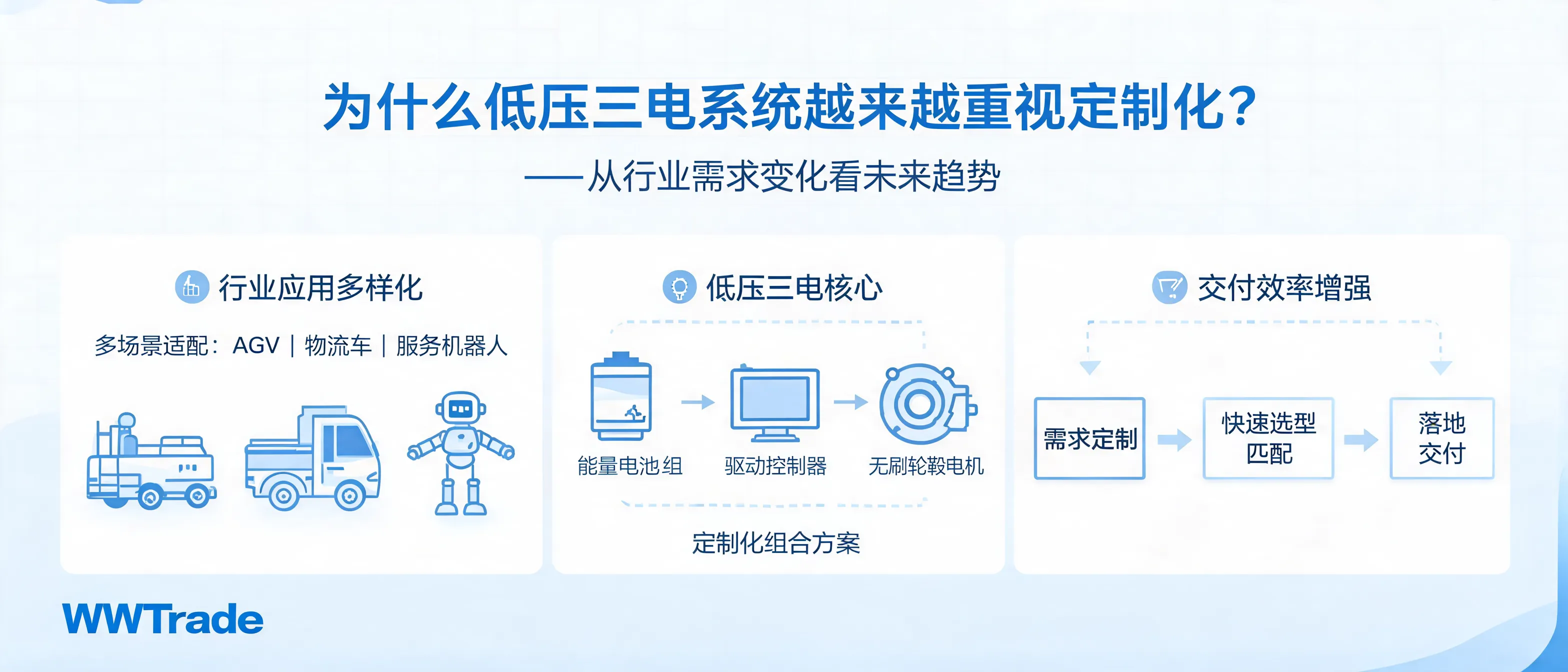
Low-voltage electrification is no longer a one-size-fits-all project. Across B2B applications, OEM/ODM teams are facing more diverse duty cycles, stricter performance targets, and tighter integration timelines—making low-voltage e-power system customization increasingly essential.
Shenzhen Jinhaixin Holdings Co., Ltd (Shenzhen, with manufacturing bases in Shenzhen, Dongguan, Changzhou, and Hainan) supports customers with system-level development and manufacturing for hub motors, motor controllers, and battery packs, including practical customization aligned to real operating conditions.
Low-voltage e-power systems are being applied across a wider range of products and environments. As use cases expand, the same “catalog” configuration may underperform, run hotter, feel noisier, or fail to match packaging constraints—driving demand for tailored motor, controller, and battery parameters.
Buyers increasingly specify measurable behavior such as launch torque feel, thermal stability, peak vs. continuous performance balance, climbing capability, and controllability. These targets are system outcomes—so customization typically involves coordination between the hub motor design, controller algorithms/parameters, and battery discharge capability.
Faster development cycles require partners that can converge on a workable configuration quickly—reducing rework caused by mismatched components. This is why many B2B teams now prefer a supplier who can support end-to-end coordination for hub motor + controller + battery pack, instead of sourcing each component separately.
In low-voltage electrification, customization is most effective when treated as a complete e-power system rather than isolated parts. A change in one element often requires adjustments elsewhere to maintain stability, safety, and consistent performance.
| Module | Typical customization focus (examples) | Why it matters for integration |
|---|---|---|
| Hub motor | Torque-speed targeting, thermal considerations, mechanical interfaces, packaging constraints | Determines real-world load capability and heat margin; mechanical fit affects assembly and serviceability. |
| Motor controller | Control strategy and parameter tuning, protection logic alignment, communication/IO matching | Controls drivability and reliability; misaligned protections can cause nuisance cutoffs or insufficient safeguarding. |
| Battery pack | Capacity vs. discharge capability, pack structure, BMS coordination, operating temperature considerations | Sets the system’s energy and power boundary; battery behavior directly impacts controller limits and motor output stability. |
| System integration | Harnessing/connectors, packaging, calibration handoff, manufacturing consistency planning | Reduces integration time-to-market and improves repeatability from prototype to production. |
Practical takeaway for B2B teams: when specifications change (load, speed, thermal environment, packaging), updating only one component can create new bottlenecks. System-level customization helps keep performance, protection, and manufacturability aligned.
Instead of choosing parts purely by headline parameters, buyers increasingly validate whether the system matches real duty cycles: acceleration frequency, average load, slopes, ambient temperature, and run time expectations. This approach reduces overdesign cost and underdesign risk.
Speed is now measured by how quickly a partner can support stable integration: interface matching, parameter alignment, and a clear path from prototype to repeatable production—rather than just shipping a sample quickly.
For low-voltage e-power systems, integration cost includes engineering iterations, compatibility troubleshooting, and quality consistency across batches. Buyers often prefer suppliers who can reduce these hidden costs through coordinated development and manufacturing discipline.
Customization is increasingly a structured co-development process. The most effective collaborations clarify boundaries early—what must be customized, what can remain standardized, and how decisions will be validated before production.
As an industrial-and-trade integrated enterprise focused on low-voltage e-power system design, R&D, customization, production, and sales, Shenzhen Jinhaixin Holdings Co., Ltd provides coordinated support across key modules:
You get a clearer path from requirements to an integrated configuration—supported by a quality management approach and an operational setup designed for stable, repeatable delivery across the company’s production bases.
If your team is evaluating a low-voltage electrification architecture or planning a hub motor + motor controller + battery pack integration, Shenzhen Jinhaixin Holdings Co., Ltd can support requirement clarification and customization planning to better fit real-world operating needs—while keeping the path to manufacturing stable and practical.