
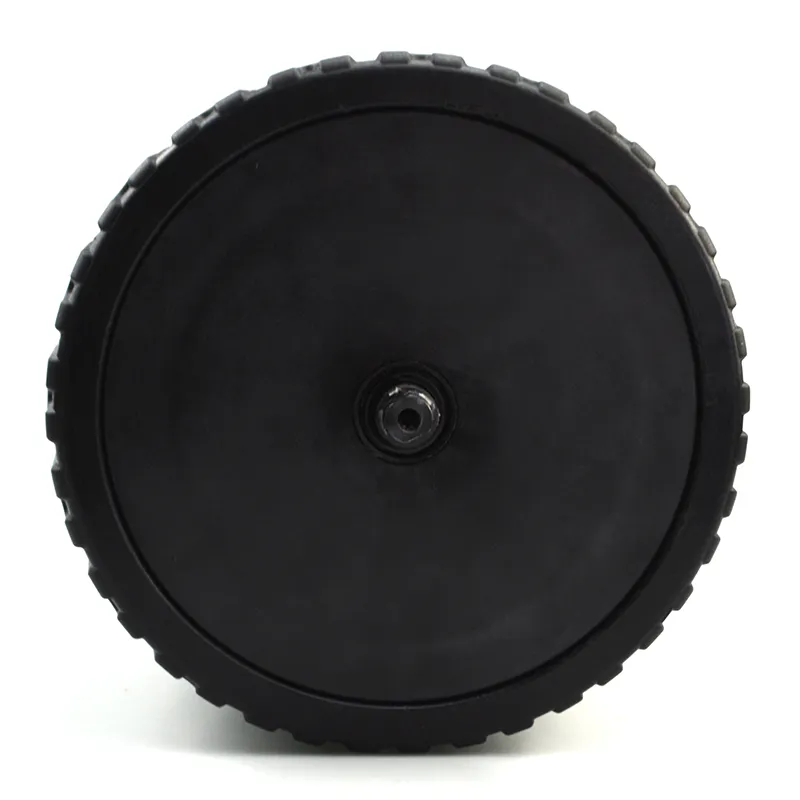
Selecting the right motor for your electric go-kart can be a daunting task. Don't make hasty decisions! In this guide, we'll break down how an 8-inch long-shaft motor (200mm diameter × 84mm tire width) can be precisely matched to small go-karts and leisure equipment. We'll cover everything from power requirements to installation convenience, helping you avoid common pitfalls and make an informed choice.
The power requirements of your electric go-kart depend on several factors. For instance, the weight of the kart and its driver significantly impact the torque needed. A heavier kart requires more torque to accelerate and maintain speed. Imagine trying to push a heavy shopping cart uphill; it takes a lot more effort compared to pushing it on a flat surface. Similarly, when your go-kart encounters a slope, the motor needs to generate enough torque to overcome gravity. As a rule of thumb, for every additional 50 kg of weight, you might need an extra 5% - 10% in torque.
Your go-kart's use scenario plays a crucial role in motor selection. If you're building a go-kart for racing, you'll need a high-performance motor that can deliver quick acceleration and high top speeds. For example, a racing go-kart might require a motor with a power output of 5 - 10 kW. On the other hand, if it's for casual entertainment or commercial use, a less powerful motor, around 2 - 5 kW, could be sufficient. Commercial go-karts often need motors that are reliable and energy-efficient to keep operating costs down.
Let's talk about the structural design of the motor. Traditional motors often come with a double-shaft design, while some modern motors feature a single-sided shaft technology. The single-sided shaft motor offers several advantages over the double-shaft design. In terms of stability, it's like the difference between a tightrope walker with a long pole (single-sided shaft) and one without (double-shaft). The single-sided shaft motor provides better balance and reduces vibration, which in turn enhances the overall driving experience. Tests have shown that single-sided shaft motors can improve transmission efficiency by up to 15% compared to double-shaft motors.
When looking at motor performance, parameters like speed, power, and heat dissipation are crucial. The speed of the motor determines how fast your go-kart can go. A higher speed motor is great for racing but might not be necessary for casual use. Power, measured in kilowatts, indicates the motor's ability to do work. A more powerful motor can handle heavier loads and steeper slopes. Heat dissipation is also important. Just like how you need to cool down after a long run, a motor needs to dissipate heat to prevent overheating. Motors with efficient cooling systems can operate at optimal performance for longer periods.
To give you a better understanding, let's look at some real-world examples. A small go-kart used for entertainment purposes, weighing around 150 kg, was fitted with an 8-inch long-shaft single-sided shaft motor. The motor provided smooth acceleration and excellent handling, even on slightly inclined tracks. In contrast, a similar go-kart with a double-shaft motor experienced more vibration and less efficient power transmission.
Now that you have a better understanding of electric go-kart motor selection, it's time to make the right choice for your project. Whether you're a hobbyist building a go-kart for fun or a business owner looking for commercial solutions, we can help you find the perfect motor. Click here to explore our product range or contact us for a customized solution.



.png?x-oss-process=image/resize,h_800,m_lfit/format,webp)


